
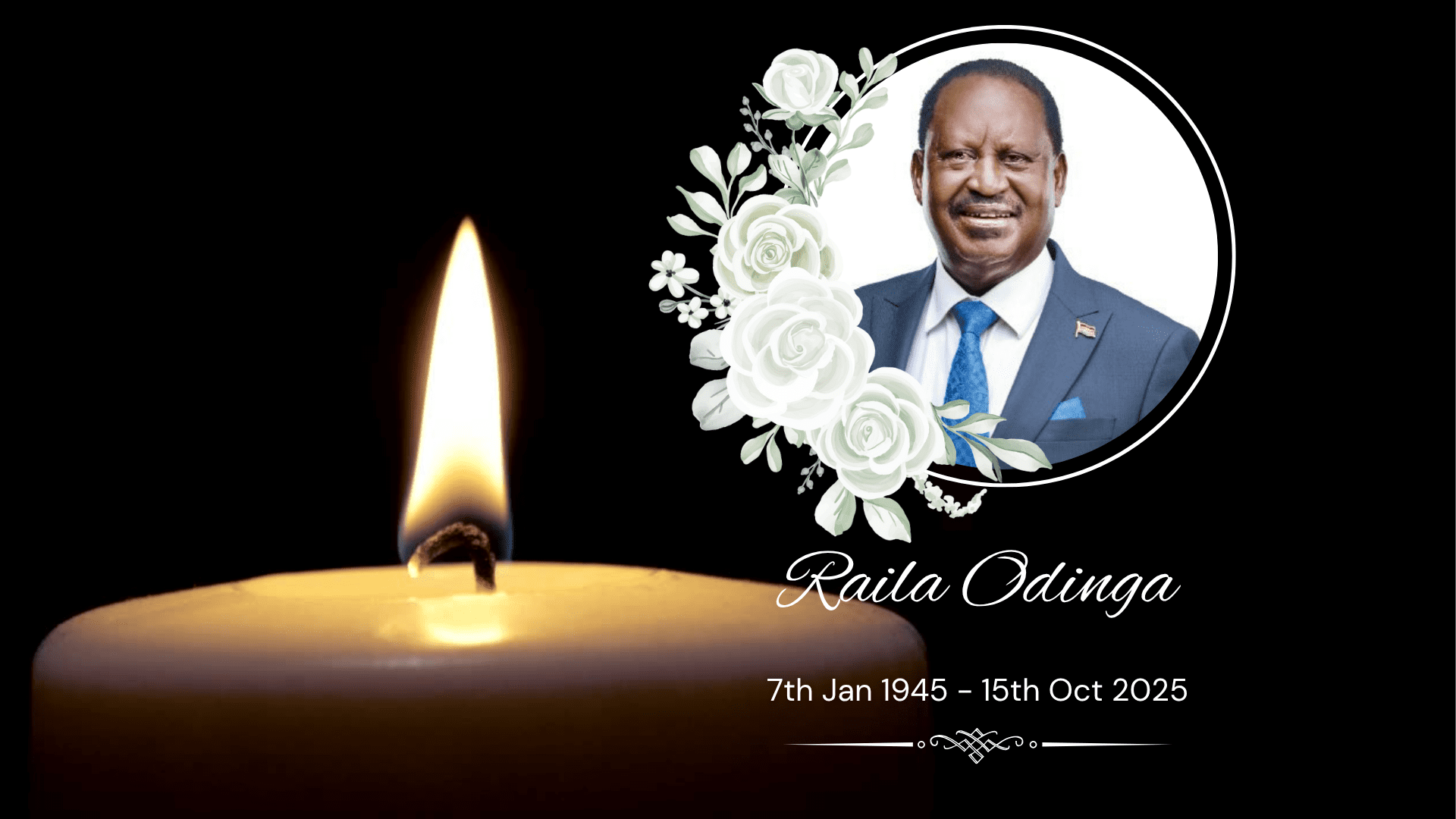
Kenya and the world woke up on 15 October 2025 to hear devastating news: Raila Amolo Odinga, one of East Africa’s most defining political figures, has died. He passed away in Kochi (Cochin), India, at age 80, having suffered a cardiac arrest during a morning walk.
Early Life and Education
- Born: 7 January 1945, Maseno, Kenya. Son of Jaramogi Oginga Odinga, Kenya’s first Vice President, and Mary Juma Odinga.
- As a young man, Raila pursued education abroad: he studied in East Germany, at institutions including the Herder Institute in Leipzig and the Technical University of Magdeburg. He earned a Master of Science in Mechanical Engineering in 1970.
- On returning to Kenya, he worked as a lecturer at the University of Nairobi between 1970-74, and then joined the Kenya Bureau of Standards, rising to Deputy Director by the late 1970s.
Early Political Activism & Struggle
- Raila Odinga’s political life was marked by opposition to single-party rule under President Daniel arap Moi. In 1982, he was accused of plotting a coup, imprisoned without trial for six years.
- After his release, he was arrested again for pushing for multiparty democracy. In 1991, he went into exile in Norway; he returned in 1992 when political reforms opened the way for multiparty elections.
Political Career: Positions & Electoral Campaigns
- Entry to Parliament: 1992 saw him win a seat in the National Assembly. He represented Lang’ata from 1992 until 2013.
- Ministerial Offices: He served as Energy Minister around 2001-2002 under President Moi’s administration.
- Presidential Runs: Odinga was a candidate for president five times (1997, 2007, 2013, 2017, 2022). Though he never won, each campaign shaped the national conversation and exposed weaknesses in Kenya’s electoral and institutional frameworks.
- Prime Minister: Following the violence that erupted after the disputed 2007 election, Odinga entered into a power-sharing arrangement. From 2008 to 2013, he served as Prime Minister in Kenya’s coalition government under President Mwai Kibaki.
Major Achievements & Reforms
- Multiparty Democracy: Odinga is widely credited as a central figure in the shift from single-party rule to multiparty democracy in the early 1990s.
- 2010 Constitution: One of his lasting legacies is Kenya’s 2010 constitution, which introduced devolved government, strengthened checks and balances, and restructured institutions.
- Continuing Opposition Leadership: For decades, Odinga was the standard-bearer for those seeking greater transparency, equity, justice, and inclusion. He was often critical of corruption and electoral irregularities.
Personal Life
- Married to Ida Betty Oyoo since 1971. The couple had four children, including Rosemary and Winnie.
- Known affectionately as “Baba” to his supporters. Also earned nicknames for being both fiery in opposition and skilled at negotiation.
Death & National Reaction
- Date of Death: 15 October 2025. He collapsed during a walk while undergoing medical treatment in Kochi, India. He was declared dead after suffering cardiac arrest.
- The nation was plunged into mourning. President William Ruto declared seven days of national mourning, describing Odinga as a patriot of uncommon courage, a unifier who sought peace and unity above power and self-gain.
- Across the country, from urban centers to rural areas, Kenya’s citizens, political leaders, civil society, and beyond expressed sorrow, gratitude, and reflection.
Legacy: What Raila Odinga Leaves Behind
Raila Odinga was more than just a politician:
- He was a voice for Kenya’s marginalized, and for citizens disillusioned by corruption and inequality.
- Besides, he was a persistent challenger of entrenched power structures. He never gave up, even after multiple electoral losses and political setbacks.
- He was an architect of political reforms, especially the 2010 constitution and other reforms pushing Kenya toward more accountable governance.
- He was also a uniting factor, and sometimes a controversial political figure. He was capable of bringing together broad coalitions, but also polarizing in certain moments.
Reflections: The Void and the Path Ahead
With his passing, Kenya loses a major figure in its democratic story. Questions emerge:
- Who will step into the gap he leaves, both in leadership of the opposition and as a moral voice in national politics?
- How will Kenya preserve and build on the institutional reforms he fought for, especially during times of political polarization?
- What lessons do younger generations take from both his achievements and his shortcomings?