





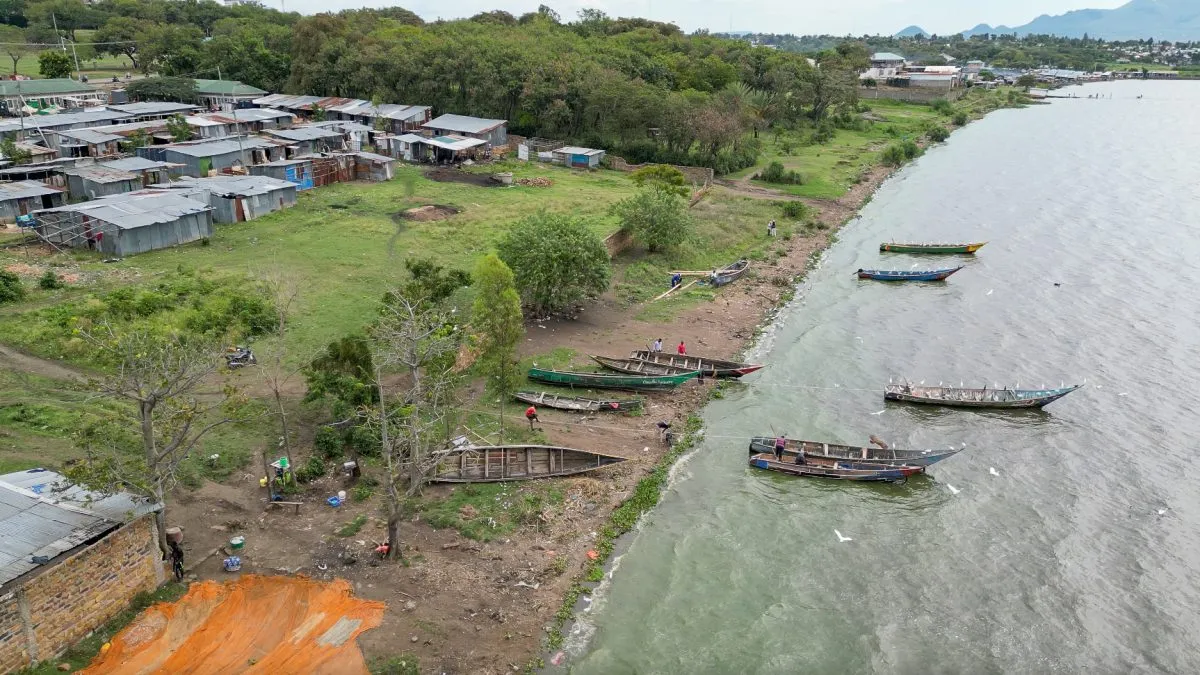
Lake Victoria is more than a body of water to the people of Homa Bay County—it’s the lifeblood of more than 1.3 million residents. These people depend on the lake for fishing, farming, and daily chores. However, increasing levels of pollution from residential, industrial, and marine sources pose a threat to the natural balance of Lake Victoria as well as the health of millions of people living in Homa Bay County. These contaminants have established an optimal environment for invasive species such as water hyacinth to flourish, resulting in the depletion of native fish populations and biodiversity.
The Homa Bay Blueprint is a bold plan to restore the lake’s ecosystem and secure livelihoods. The Blueprint aims to cut lake pollution by 20% in three years. The Homa Bay Blueprint was launched and will be implemented as a partnership between the Global Partners for Development, the Republic of Kenya, 374Water, the County Government of Homa Bay, and the University of Nairobi.

The Homa Bay Blueprint will have a data hub managed by local scientists and academics from the University of Nairobi. These individuals will be tasked with collecting, consolidating, and analysing the region’s first-ever complete dataset on lake water quality. The hub will incorporate cutting-edge GIS technology, an easily navigable app, and community connections to update and disseminate this data on a regular basis. This will, in turn, enable local organisations, Homa Bay residents, and the government to tackle factors causing pollution and keep track of lake conditions for safer swimming, fishing, and harvesting of water.
Global Partners for Development (GPFD) and 374Water have also formed a partnership to utilise advanced AirSCWO technology, aiming to revolutionise waste management and promote clean-tech sanitation by converting garbage into essential resources like as clean water and valuable minerals. The objective of this partnership is to develop a reproducible framework for worldwide implementation that emphasises tangible outcomes and enduring dedication.
The Homa Bay Blueprint will incorporate a technology known as AirSCWO. This is an efficient decentralized solution for treating a broad range of waste feedstocks rapidly, continuously, cost-effectively, and with unprecedented reliability. It harnesses the power of supercritical water without compromising operational, performance, and resource recovery targets. AirSCWO technology will be used in Homa Bay to convert trash into essential resources, such as clean energy and minerals, through its water purification process to benefit the local communities. The elements that are extracted will be recovered and marketed as fertiliser for agriculture. At the same time, the heat generated by the process can be utilised to dry grains and fish for local enterprises. Future projects that involve larger AirSCWO units are expected to generate power and therefore create lucrative new market prospects in the region.
This program is expected to directly benefit the local communities that live along the shores of Lake Victoria. However, the benefits of rejuvenating the lake will extend to the wider region and beyond in the long term.
Global Partners for Development is a US-based organization whose mission is to advance community-led initiatives that improve education and public health in East Africa. Global Partners was founded in 1978 as a membership organisation known as World Runners International Foundation. The initial objective was to concentrate efforts on and cultivate support for the eradication of hunger and famine globally. In 1993, World Runners changed its name to Global Partners. They started collaborating directly with East African community leaders in Tanzania, Kenya, and Uganda to seek out and execute water, health, and environmental projects.

Find More on Our Socials




The county must safeguard our lake. Luos are nothing without lake victoria.